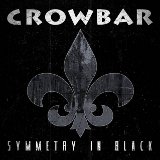
The lineup changes with almost every album, but Crowbar's reliable output doesn't. They continue their incremental approach towards album development with Symmetry in Black, another album that doesn't change their sound much from the previous album, but proves that it perhaps doesn't need much changing. All the sludge and groove-driven power is still there, but the man behind it is older and more experienced with every album, and this shows in both the music and lyrics.
The band had streamed Walk With Knowledge Wisely, and it's clear why they did that one: It's a guaranteed Crowbar-fan-pleaser, filled with Kirk Windstein's shrieked vocals, groovy guitar riffs, and tons of palm-muting that complements the heavy bass -- in fact, the song ends with nothing but palm muting, slower and slower like a great machine grinding to a halt. But Symmetry in White is fairly soft for Windstein, and The Taste of Dying, though choppier and more Pantera-like, is also quite melodic on the chorus; again in this one, Windstein manages to hold himself back just enough to sound slightly gentler. The guitars seem to me to have a smoother, tighter distortion than the last album, but Tommy Buckley's smashing of the drum kit is unchanged (and still excellent), and part of the genius of the Crowbar sound, where the guitars' downtuned chords coincide with the deepest point of the bassline, continues. The riffs have always been good, but Reflection of Deceit deserves a special mention for its infectious verse riff and its grungy hooks, like something from a heavier version of Alice in Chains.
Windstein's voice hasn't changed either; even on the quieter songs, it's the tormented roar of a giant, though a gentle giant, as exhibited in Amaranthine. Not only is the guitar on this one clean, his voice cleans up more than one who'd heard his music before could have imagined possible. Throughout the album, the lyrics, too, for all the sonic brutality and Windstein's rock-grinder of a voice, are mostly positive; they're uplifting and intensely personal, containing near-religious themes of compassion and healing after intense suffering in the past. The "suffering" part, of course, can easily be detected; as in previous albums, one wouldn't call Windstein's voice "world-weary" so much as "supporting multiple worlds on shoulders, and about to be crushed under them".
I wouldn't like to leave the impression that this is a kinder, gentler Crowbar album, though. Even though there are a few quieter pieces, tracks like Ageless Decay hold back from much of a melody and concentrate on speed and heaviness, and so does the chorus of Foreboding, a fine combination of the light and dark, soft and harsh. Shaman of Belief and Teach the Blind to See, though different in rhythm, are similar in lyrical content and heaviness, though I liked Teach the Blind to See's riffing slightly better. But the real hard-core sludge is at the end of the album in the last few tracks, ending strangely on The Piety of Self-Loathing, an doomy instrumental with what sounds like an organ far back in the mix as the album fades out.
Symmetry in Black makes only small tweaks to a sound that many would argue is already classic; one can immediately tell it's a Crowbar album and the small changes only enhance it. It's got a softer and melodic sound in places, but these provide the album a pleasing -- and quite fitting, given the name -- set of contrasts for the listener.
Soundcloud of the first track: https://soundcloud.com/centurymedia/crowbar-walk-with-knowledge.
Reviewed by Andy — July 21, 2014