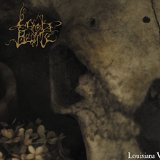
Louisiana Voodoo
I Shalt Become
- Style
- Atmospheric Black Metal
- Label
- Pesanta Urfolk
- Year
- 2013
- Reviewed by
- Andy
I Shalt Become has always had a strangely disruptive, nerve-wracking feeling to their sound; my fellow reviewer Alex compared their last album to being bitten by an exotic bug out in the bush. And why not? I just picked up their latest, Louisiana Voodoo, blindly, based on their record label (which has got a very high reputation with me for weird, high-quality releases) rather than from hearing them before, and I see exactly what he's talking about. Louisiana Voodoo manages to be beautifully rendolent of atmosphere, pensive and haunted all at once, with a delirious edge to it that confuses and fascinates the listener.
Someone inevitably compared them to a US version of Summoning, but the two bands could not be more different as far as I can tell. Summoning, for all their atmosphere, always had a tightly controlled set of hooks and rhythm per song, brought on by their principals' habit of listening to electronic and military music, with very little room for departure into randomness; Louisiana Voodoo, on the other hand, is very little but random. Lust starts the album with a queasy set of violins against a dissonant piano and breathy noise, almost like the bizarre orchestra of S. Holliman, the man behind the music, is tuning up. It launches into a rather positive-sounding major-key melody, quickly breaking off into a combination of strings, horn, and piano backgrounding Holliman's snarled and groaned vocals, sounding like a chorus of zombies dully and hopelessly calling to be let into the listener's abode, with the soundtrack of a horror movie playing in the background. The next scene of the "movie" is then continued in Strangers, though with more drumming than before, provided by the unspectacular but solidly competent A.J.S.; Total Perspective Vortex at first appears less complex than this, but the listener soon discovers this is an illusion, as there is a lot going on (guitars, electronic sawtooth synths, a choral background, more strings, and a lovely piano solo partway through the piece) behind the scenes.
As for the lyrics, they are almost completely incomprehensible in the songs, but are spare, haiku-like bits that are nonetheless wonderfully evocative. The title track, for instance, has only five lines of lyrics, but lyrics like with "I've been known to practice Santeria / Oft to conjure and exorcise your fevered dreams" are both poetic and pack a lot of the song's meaning in a very small space. Rain, in addition to being about rain, sounds like a dark, drizzling day as well, with the sound of rain pouring down in the background and the piano tinkling the most recognizable riff again and again. Riot is more action-filled; everything goes faster and the background string section plays quickly and in a disciplined manner, but as in all these songs, disturbing, atonal riffs break into the originally well-structured song and reduce it from a fairly well-grounded orchestral arrangement to a dreamily horrific mess of chantings, grunts, and staggering string-and-piano phrases. Braquemard is more soaring in melody, but with a subterranean current of unease under it, like a tower built on a termite-ridden foundation. It also contains a little piano riddle throughout that reminds one of the Halloween soundtrack, or maybe the soundtrack to a political attack ad in an American election (I tried pretty hard to make a short speech about what a rotten horse-thief Candidate X was with that piano line playing in the background, but it's just a little too fast and chaotic to convince the voting public -- oh well).
The piece de resistance of the album is the 19-minute long The Rats in the Walls, a very different song in some ways from the preceding tracks for its techno flourishes, buzzing synths, and occasionally a flute). Around six minutes in, everything gets substantially quieter for a few minutes until Holliman's vocals burst out with a sound of pent-up rage, subsiding into subdued growls. There are some other interesting parts, including several passages where the whole thing becomes rather muted, even the drums getting hollower and dimmer, then turning back up to loud again.
Louisiana Voodoo is strange even by atmospheric black metal standards, but that is, of course, the point. I Shalt Become flouts some of the traditional black metal customs pretty flagrantly, while losing nothing of the spirit of their chosen musical genre and producing nothing but...well, maybe not happiness, but unease and disturbance of mind, at least, in the listener, which is precisely the desired effect.
Reviewed by Andy — December 15, 2013