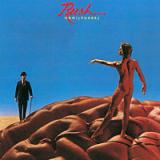
Hemispheres
Rush
- Style
- Progressive Rock
- Label
- Anthem/EMI
- Year
- 1978
- Reviewed by
- James
2112 or Moving Pictures may be most fans' favorite Rush albums, but their 1978 opus Hemispheres will always be my far and away top pick. So much so, that I actually considered quoting this as a classic, but decided against it on the ground that many will disagree with me. Of course, 1976-1981 was perhaps Rush's most exciting period creatively, and it's fitting that this record comes slap bang in the middle of those years. Everything here comes together perfectly, the band sound the tightest they've ever been (even for a band as notoriously well-rehearsed as Rush), and they've written perhaps their most consistent collection of songs here. Then again, there are only four of them, so there is definitely no room for filler.
Hemispheres is very much a transitional record, being a document of the band heading towards Permanent Waves from A Farewell To Kings. The record is bookended by the progtastic Cygnus X-1 Book II and La Villa Strangiato, and in the middle, we set foot in the land of song, place the band would make a permanent residence before too long. There's a stronger presence of synths on here too, a element of the band's sound that would become increasingly prominent throughout the next decade. But without further ado, we open up with the band's last great epic, a direct sequel from A Farewell To Kings' Cygnus X-1 closer, and it may well be the best track the band have ever done. Clocking in at 18-minutes, half the album's length, it manages to be utterly enthralling throughout. It's a testament to the band's songwriting abilities, with each of the track's six segments being nothing less than stellar. I particularly like the odd, nagging intro riff to the Apollo/Dyonisus sections. The band could not have thought of a better way to lay their extended prog suites to rest.
After that masterwork, it would be very easy for Geddy, Neil and Alex to knock out three afterthoughts to fill out the record. But here, we move into the more conventional middle section of the album, and it's almost as great as the first side. Circumstances is the hardest rocking track here, and harks back a little to the band's earlier work. Unfortunately, it seems to have been forgotten by most, a great shame as it's a rather fetching little song with some outstanding bass work. The Trees is the most well known song here, and it's the one which nods the most to later works. It seems like an attempt to be as thoroughly progressive as possible within a five minute framework, while still being as catchy as possible. It's mostly of note for it's melodic middle section, which recalls the similar section of Red Barchetta that would appear just three years down the line. Lyrically, it's one of their most political songs (though of course there's been a slight political slant to their work ever since Peart joined). Although the band have never truly explained the meaning, it seems to me to be a rather thinly-veiled allegorical attack on Communism. Make of it what you will, I guess, and feel free to just listen to it as a song about some trees.
And so we come to our conclusion, with the instrumental La Villa Strangiato. It's a nine minute showcase of the band's musical ability, and somehow it flies by, perhaps due to the sheer diversity of each of its sections. It shouldn't work, yet it totally does, and perhaps is the strongest instrumental in the band's extensive canon. After one listen to this record, I was utterly hooked on Rush's sound, and spent a great deal of time and money trying to find another of their records up to the same standard. Although I encountered a ton of great music along the way, Hemispheres has still never been beaten for me. Despite it being their best, Hemispheres is not an ideal starting point for the band, as there's the slightly disheartening feeling that's it's all downhill from here. The low points are still better than most other records, mind.