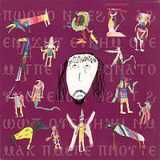
Black Ships Ate The Sky
Current 93
I'd be lying if I was a die-hard fan of David Tibet's bewildering body of work as Current 93, yet for whatever reason he's probably one of my most respected musicians about today ( I have a certain respect for anyone who's been about as long as he has and is still releasing quality music). Over a near 30-year career, starting out in Genesis P-Orridge infamous Psychic TV, Tibet has released a lengthy array of work ranging from the industrial terrorism of Dog's Blood Rising to this year's psych-rock opus Aleph At Hallucinatory Mountain. And on top of all that, he's collborated with everyone from the legendary Nick Cave, Death In June's Douglas P, and even the likes of Maniac, Garm and Greg Anderson. And although his music is generally far removed from metal (with a couple of exceptions here and there) it's his presence at the outer fringes of metal that I believe makes Current 93 a much needed addition to any of our readers' library. And with a review of Aleph At Hallucinatory Mountain coming in the near future, what better time to have a look at Tibet's last major work.
Black Ships Ate The Sky gained a significantly greater amount of press than Current 93 had received in some time, partly because it was a return to form for Tibet after some time in the artistic wilderness, and also for the notable guest list who show up, ranging from frequent Tibet collaborators Baby Dee and Shirley Collins, to personal favorite of mine Will Oldham (known to most as Bonnie Prince Billy) and the more mainstream likes of Antony Hegarty (he of Antony And The Johnsons, at this point riding high on the success of I Am A Bird Now) and Soft Cell man Marc Almond. They each have a turn at singing Idumea, the 18th Century Wesley hymn that holds the apocalyptic concept of the album (which I still don't understand) together. Each vocalist interprets the song in his or her own special way, and it certainly leads to very interesting results. Standouts include Marc Almond's version, lent a certain emotional clout from the fact that he was still recovering from a near fatal motorbike accident at the time and Pantaleimon's oddly sweet folk rendition. Antony Hegarty's take on the piece is remarkably uncomfortable listening. The combination of his incredibly strange voice and an incredibly dry, claustrophobic mix (it literally sounds as if he's singing directly into your ear if you're wearing headphones) makes for the record's most oddly disturbing moment. My personal favorite is Will Oldham's, who's cracked Southern tones give off a weary preacherman vibe that fits the piece perfectly (I'll admit to being personally biased here, mind). There's the odd duff version, notably ex-Throbbing Gristle's Cosey Fanni Tutti's staggeringly bland reading, and Tibet himself who sounds bizarrely restrained here. But, considering it's still the same song repeated 10 times, and 18th Century hymns are not known for their entertainment value it works really well. It provides us with some much needed breather's from Tibet's voice, which as wonderful as it is in small doses (this man should read the BBC football results), over a whole album (and this is a lengthy one) becomes oddly fatiguing, as if he's chucking copies of The Lesser Key Of Solomon at your head while singing/ranting at you.
Onto Tibet's songs proper, then, and if you're even remotely familiar with his classic work you'll know what to expect. It's all sparse, acoustic melodies, sounding a bit like a better recorded version of Ulver's Kveldsannger, topped off with Tibet's demented rantings. His lyrics are as rambling as ever, although as always strongly influenced by his Christian faith (despite having a strong interest in the occult and links to Crowley's Ordo Templi Orientis). This time out, he's gone all apocalyptic on us. Black Ships Ate The Sky is obsessed with Christian eschatology, the recurring theme of the black ship being a metaphor for... something, anyway, though damned if I know what. Elsewhere, Abba Amma (Babylon Destroyer) deals with the fall of Babylon, a major feature of the Biblical book of Revelation, a book primarily concerned with the end times. I'm assuming the references to Caesar throughout the album refer to early Christian belief in Nero as the Antichrist, and the still commonly-held belief that the Antichrist will come in the form of a world leader (I'm sure Tibet has his theories on who that may be). Fascinating stuff, even if you're not remotely religious.
Most of the songs are fairly similar, following the aforementioned template, though they all make for pleasant listening and it's really more about atmosphere than catchy tunes. Still, highlights include Bind Your Tortoise Mouth, with a guitar melody so good they could have constructed an entire album around it, and Black Ships Last Seen South Of Heaven, with Tibet rattling of the most bilious vocal performance of his life (and somehow fits some kind of melody around it). There's a feeling throughout the album that it's all building to something, and that moment comes in the title track. The acoustics are jettisoned in favour of a storming industrial metal stomp and Tibet, who's kept a bubbling undercurrent of malevolence throughout the album, essentially loses it. The manic chanting of “Who will deliver me from myself?”, building in intensity until Tibet is shrieking rather than singing will stamp a permanent impression on your brain. It clearly had an effect on Maniac, as the ex-Mayhem/current Skitliv frontman was so moved by the statement that he had it tattooed across his chest. We wind things down with Why Caesar Is Burning Part II, the sparsest track on here and the perfect antidote to the aural Armageddon of the title track. Shirley Collins sings us out with, you've guessed it, Idumea. The backing is suitably medieval, although her interpretation is overly similar to many of the other female vocalist her voice has a suitably aged, worn quality. Speaking of which, Marianne Faithful would have fit perfectly on this album. Perhaps Tibet should call her some time.
Yes, there are highs and lows, but they're all part of the journey that is Black Ships Ate The Sky. Every piece of music feels integral to it somehow, and yet as silly as it sounds, it feels more like a piece of art than simply a piece of music. It's a bloated, overlong, flawed record, and yet it's something of a modern classic, and wholeheartedly recommended to any fan of experimental music. To release an album of that quality after such a lengthy and prolific career is quite an achievement for David Tibet, and I hope time will judge Black Ships Ate The Sky as on par with Thunder Perfect Mind or All The Pretty Little Horses in his repetoire.
Reviewed by James — June 7, 2009